

Estate administration is the court-supervised process of validating a will, inventorying assets, paying creditors, and distributing remaining property to beneficiaries under the Maine Probate Code (MRS Title 18-C).
Spinnaker Probate Group handles every stage of Maine probate — from the initial court application through final asset distribution — under a fixed-fee engagement, drawing on Daintria W. McClure’s combined J.D. and active CPA credential.
Key Takeaways
- Maine’s filing fee scales with estate value under §1-602 — it is not a flat $20 charge, and probate deadlines start from different points.
- Standard, uncontested Maine informal probate typically closes in 9 to 12 months.
- Maine’s estate tax threshold is $7.16 million in 2026, with no portability between spouses.
- Intestate succession depends on which relatives survive the decedent, not a fixed sequential order.
Probate deadlines in Maine start at different points for different tasks. Spinnaker Probate Group offers a free consultation to map the specific deadlines that apply to an estate before procedural errors add avoidable delay.
What Does a Personal Representative Do in Maine?
A personal representative — the individual the county Probate Court appoints to manage the estate — carries fiduciary responsibility from the date Letters are issued through final distribution. MRS Title 18-C, Article 3 assigns the core duties.
The personal representative:
- Files the probate application in the county where the decedent was domiciled at death
- Prepares and files an inventory of estate property within three months after appointment, listing fair market value and any encumbrances as of the date of death
- Publishes a creditor notice once a week for two successive weeks in a county newspaper
- Reviews and pays valid creditor claims
- Distributes remaining property to beneficiaries once the claims period has run
Every obligation and filing deadline for Maine personal representatives is governed by statute and enforced by the county Probate Court. An estate administration attorney can help a newly appointed representative sequence these steps correctly from day one.
Real property, retirement accounts, and business interests are the asset classes most likely to be undervalued in a probate inventory when a professional appraisal isn’t obtained early — a gap that a CPA-credentialed reviewer, such as Attorney McClure, is positioned to catch before it becomes a downstream accounting problem.
How Long Does Probate Take in Maine?
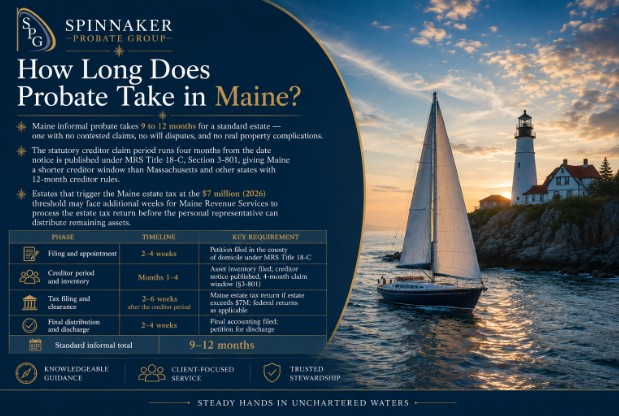
Maine informal probate closes in 9 to 12 months for a standard estate — one with no contested claims, no will disputes, and no real property title complications. Estates involving disputed valuations, hard-to-sell real estate, or business ownership commonly extend well past that range.
The statutory creditor claim period runs four months from the date of first publication under 18-C M.R.S. § 3-801, and the nine-month absolute claims bar under 18-C M.R.S. § 3-803 sets the outer boundary for creditor exposure.
| Phase | Timeline | Key Requirement |
| Filing and appointment | 2–4 weeks | Application filed in the county of domicile under MRS Title 18-C |
| Creditor period and inventory | Months 1–4 | Inventory due 3 months after appointment; creditor notice published; 4-month claim window (§3-801) |
| Tax filing and clearance | 2–6 weeks after the creditor period | Maine estate tax return (Form 706ME) if the estate exceeds $7.16M; federal returns coordinated with outside tax professionals |
| Final distribution and discharge | 2–4 weeks | Final accounting filed; closing statement or petition for discharge |
| Standard informal total | 9–12 months |
Each phase of the Maine probate timeline carries its own statutory deadline and common delay trigger. Families in Knox County and surrounding areas can review Rockland-specific probate procedures for county-level detail.
What Does Probate Cost in Maine?
Maine’s probate filing fee is set by statute and scales with the estate’s value — it is not a flat $20 charge. Separate from that fixed court fee, professional and administrative costs (attorney fees, appraisals, tax preparation) commonly range from the low thousands into five figures, depending on the estate’s size and complexity; the figures below are typical market ranges rather than a guaranteed total for any specific estate.
| Cost Component | Amount |
| Filing fee — estate $10,000 or under | $40 |
| Filing fee — estate $100,001–$150,000 | $325 |
| Filing fee — estate $500,001–$750,000 | $700 |
| Filing fee — estate over $2,000,000 | $1,200, plus $250 per additional $500,000 |
| Filing a will for probate without an appointment | $20 |
| Certificate of appointment | $10 single / $20 double |
| Court record copies | $1 per page |
| Attorney fees (standard estate, market range) | $3,000–$5,000+ |
| Real property appraisal | $300–$500 per property |
| Maine estate tax return prep (Form 706ME, if required) | $1,500–$3,000+ |
| Federal estate tax return (Form 706, if required) | $2,000–$5,000+ |
| Bond premium (if court-ordered) | 0.5%–1% of estate value |
| Newspaper publication (creditor notice) | $100–$300 |
The full filing-fee schedule, with every estate-value tier, is set out in 18-C M.R.S. § 1-602. The Maine probate cost guide breaks down every other fee category by estate type. When an estate requires tax return preparation, Spinnaker coordinates with outside tax professionals to align filings with the probate timeline.
A cost estimate based on an estate’s actual assets helps prevent surprises after filing begins. Spinnaker Probate Group provides that estimate as part of a free consultation.
When Can a Maine Estate Avoid Full Probate?
Maine allows certain assets to transfer entirely outside the formal probate process:
- Funded revocable living trusts governed by the Maine Uniform Trust Code (MRS Title 18-B) bypass probate because trust assets are not part of the probate estate — though a funded trust still requires its own administration
- Jointly held property with survivorship rights transfers directly to the surviving owner
- Payable-on-death accounts and properly designated beneficiary accounts transfer directly to named beneficiaries without court involvement
- A small estate affidavit process under 18-C M.R.S. § 3-1201 covers personal property — not real estate — for estates where the total value, less liens, does not exceed $40,000, adjusted annually for inflation
The affidavit process requires at least 30 days to have passed since the date of death, with no application to appoint a personal representative pending.
Structuring these transfers before death — rather than relying on the probate court to sort them out afterward — is the purpose of Spinnaker’s estate planning services for Maine families, and of trust administration once a trust is in place.
How Does the Maine Estate Tax Affect Probate Administration?
Maine imposes a state estate tax on estates valued above $7.16 million in 2026 under MRS Title 36. Maine Revenue Services administers the tax through Form 706ME at three progressive rates: 8%, 10%, and 12%.
Unlike the federal estate tax exemption ($15 million per individual in 2026 under the One Big Beautiful Bill Act), the Maine threshold has no portability — a surviving spouse cannot claim the deceased spouse’s unused exemption.
The $7.16 million threshold shields most Maine families from the state estate tax. Families with substantial real property holdings, business interests, or multi-generational land — including inherited camp properties along the coast or interior — should verify whether combined asset values approach or exceed the threshold.
Spinnaker coordinates with outside tax professionals whenever a Maine Form 706ME or federal Form 706 is required, aligning those filings with the probate timeline.
What Happens When a Maine Resident Dies Without a Will?
When a Maine resident dies intestate, 18-C M.R.S. §2-102 and §2-103 direct how the estate passes — and the outcome depends on which relatives survive, not a fixed spouse-then-children-then-parents order.
| Surviving Relatives | Spouse’s Share |
| No surviving descendant or parent | Entire estate |
| Descendants all shared with spouse, spouse has no other descendants | Entire estate |
| No descendant, but a parent survives | First $300,000, plus 3/4 of the balance |
| Descendants shared with spouse, spouse has other descendants of their own | First $100,000, plus 1/2 of the balance |
| Decedent has descendants not shared with spouse | 1/2 of the estate |
Any portion not passing to a spouse passes to descendants, then to parents, then to descendants of parents, under the priority order in §2-103.
Intestate estates follow the same probate timeline and procedural requirements as testate estates, but the Probate Court appoints a personal representative rather than confirming the individual named in a will. Title 18-C governs the statutory hierarchy and related complications when a Maine resident dies without a will.
When Should Families Contact a Maine Probate Attorney?
Straightforward Maine estates with clear heirs and complete records can often proceed with limited outside help. Several situations commonly turn a routine administration into a longer or more complicated one:
- Disputed or hard-to-obtain asset valuations, particularly real estate or business interests
- Real property that is difficult to sell or has a title defect
- Missing or outdated beneficiary designations
- Uncertainty about which creditors have valid claims
- Business ownership requiring separate valuation or buy-sell coordination
- Incomplete financial records for the decedent
A dual-credentialed review matters most where valuation and tax questions overlap with the probate filing itself—the exact intersection Attorney McClure’s CPA background is built to handle in-house rather than through referral.
Frequently Asked Questions
How long does informal probate take in Maine?
Informal probate in Maine closes in 9 to 12 months for a standard estate under MRS Title 18-C. The four-month creditor claim window under §3-801 runs from the date of first publication, and the nine-month absolute claims bar under §3-803 sets the outer boundary for creditor exposure.
What is the Maine estate tax threshold in 2026?
Maine taxes estates valued above $7.16 million in 2026 at graduated rates of 8, 10, and 12 percent, administered through Form 706ME. The threshold is not portable between spouses. Families with real property, business interests, and retirement accounts should verify combined values against the threshold.
What does probate cost in Maine?
The filing fee scales with estate value under 18-C M.R.S. §1-602, from $40 for estates of $10,000 or less to $1,200 or more for larger estates. Attorney fees, appraisals, and tax preparation are separate and typically range from the low thousands to $10,000 or more, depending on complexity.
Can probate be avoided in Maine?
Funded revocable trusts governed by MRS Title 18-B, jointly owned property with survivorship rights, and payable-on-death or designated beneficiary accounts all transfer outside probate. Estates with personal property valued at or below the small estate threshold under §3-1201 may qualify for affidavit collection.
What is the role of a personal representative in Maine?
The personal representative files the probate application in the county of domicile, inventories estate assets within three months of appointment, publishes a creditor notice for two successive weeks, pays valid debts, and distributes remaining property under the will or intestacy statute.
What happens if someone dies without a will in Maine?
18-C M.R.S. §§2-102 and 2-103 distribute the estate based on which relatives survive. A spouse’s share ranges from the entire estate to half, depending on surviving descendants and parents; any remainder passes to descendants, then parents, then their descendants in turn.
What is the federal estate tax exemption in 2026?
The federal estate tax exemption is $15 million per individual and $30 million for married couples under the One Big Beautiful Bill Act, signed into law on July 4, 2025. The exemption is permanent and indexed for inflation starting in 2027. The top federal rate remains 40%.
What is the difference between informal and formal probate in Maine?
Informal probate is processed by the register without a hearing and typically closes in 9 to 12 months for uncontested estates. Formal probate involves a judge and a hearing on the initial appointment; ongoing court oversight of major actions applies only under separate supervised administration, not automatically at every later step.
How do I get certified copies of probate documents in Maine?
The county Probate Court issues certified copies of wills, Letters, and other probate documents at $10 per single certificate under 18-C M.R.S. §1-602. Each county clerk accepts requests by mail or in person. The process for getting a certified copy in Maine varies by county.
How long do creditors have to file claims in Maine?
Creditors must file claims within four months of the first publication of the creditor notice or within nine months of the date of death, whichever is earlier, under 18-C M.R.S. §§3-801 and 3-803. Claims filed after both deadlines are permanently barred against the estate.
Probate deadlines and creditor claim periods do not wait for convenience. Spinnaker Probate Group can confirm which probate track applies and outline a Maine timeline.
Legal Note: This page provides general legal information only and does not constitute legal advice or establish an attorney-client relationship. Probate laws, estate tax thresholds, and court procedures in Maine are subject to legislative and regulatory change. Personal representatives and families should retain a licensed probate attorney for advice specific to their situation and applicable law.