
Written by Attorney Daintria W. McClure, CPA, Esq., Massachusetts Probate Attorney, BBO# 654026 | Last Reviewed: February 2026 | Covers Massachusetts Probate and Family Court practice under G.L. c. 190B and G.L. c. 202.
Massachusetts intestacy law assigns probate property under M.G.L. c. 190B, §2-102 and M.G.L. c. 190B, §2-103 when a person dies without a valid will. A surviving spouse and descendants usually inherit first.
The surviving spouse’s share may change when the decedent has a living parent or has descendants from another relationship under M.G.L. c. 190B, §2-102.
Intestacy removes personal choice. Massachusetts law decides who receives probate assets and how the probate estate is divided.
Beneficiary designations and survivorship titles still control many transfers, so asset ownership drives outcomes on an asset-by-asset basis.
Key Takeaways
- Massachusetts distributes probate property under intestacy through M.G.L. c. 190B, §2-102 and M.G.L. c. 190B, §2-103 when no valid will controls the estate.
- Massachusetts reduces a surviving spouse’s share in parent-survival and blended-family scenarios under M.G.L. c. 190B, §2-102, so a spouse does not automatically inherit 100% in every family structure.
- Massachusetts divides descendant shares per capita at each generation, pursuant to M.G.L. c. 190B, §2-106, so grandchildren can inherit directly when a child predeceases the decedent.
What Intestacy Means In Massachusetts And What Property It Controls

Massachusetts intestacy rules govern the probate estate only. The probate estate is the set of assets titled in the decedent’s name alone and lacking a controlling beneficiary or survivorship transfer.
Many high-value assets transfer outside probate, so the people who inherit under intestacy may not receive every asset the decedent owned.
Probate Assets Vs Non-Probate Assets
Probate Assets That Usually Follow Intestacy
Probate assets commonly include:
- Real estate titled in the decedent’s name alone
- Bank accounts with no payable-on-death beneficiary
- Vehicles titled only to the decedent
- Personal property, including jewelry, furniture, and collectibles
Massachusetts assigns who inherits these probate assets through M.G.L. c. 190B, §2-102 and M.G.L. c. 190B, §2-103.
Non-Probate Assets That Usually Bypass Intestacy
Non-probate assets commonly include:
- Life insurance proceeds are controlled by a beneficiary designation
- Retirement accounts controlled by a designated beneficiary
- Joint accounts titled with rights of survivorship
- Trust-owned assets distributed under the trust instrument
A failed or missing beneficiary designation can push an asset back into the probate estate, which reactivates intestacy rules for that asset.
Take Control of Tomorrow by Acting Today
Schedule your consultation with Spinnaker Probate Group and gain peace of mind for the future.
Quick Definitions. Decedent, Heirs, Probate Estate, Personal Representative
A decedent is the person who died.
Heirs are the people who inherit probate property under the Massachusetts intestacy law in M.G.L. c. 190B, §2-103.
A probate estate is the set of probate assets that the Probate and Family Court supervises during administration.
A personal representative is the court-appointed fiduciary who collects estate assets, pays enforceable debts and taxes, and distributes remaining probate property to heirs.
The Massachusetts Intestacy Inheritance Chart
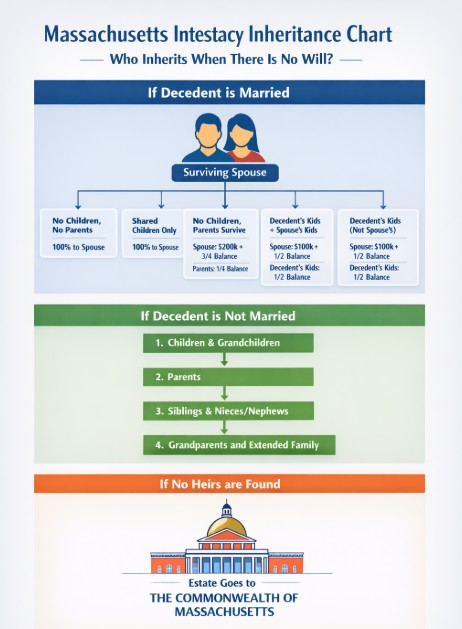
Massachusetts uses a scenario-based spouse-share approach and a priority order for all other heirs.
Massachusetts defines spouse shares in M.G.L. c. 190B, §2-10,2, and defines non-spouse heir priority in M.G.L. c. 190B, §2-103.
If You Are Married. What The Surviving Spouse Inherits
Massachusetts grants the surviving spouse 100% in limited structures under M.G.L. c. 190B, §2-102(1).
Massachusetts may reduce the spouse’s share when a parent survives or when the decedent has descendants who are not descendants of the surviving spouse under M.G.L. c. 190B, §2-102(2)–(4).
If You Are Not Married. Children, Then Parents, Then Siblings, Then Next Of Kin
Massachusetts distributes the intestate estate to descendants first, then to parents, then to the descendants of parents, and finally to grandparents and their descendants under M.G.L. c. 190B, §2-103.
If There Are No Heirs. When Property Can Escheat To The Commonwealth
Massachusetts can transfer property to the Commonwealth when no heir qualifies under the statutory order. Friends and charities do not inherit by intestacy. A friend or charity inherits only through a will, a trust, or a beneficiary designation.
Massachusetts Intestacy Chart. Who Inherits What?
| Scenario | Who Inherits Under MA Intestacy | Share (Per Statute) | Governing Section |
| Spouse only, no descendants, no parents | Surviving spouse | 100% | §2-102(1)(i) |
| Spouse plus shared descendants only, and spouse has no other descendants | Surviving spouse | 100% | §2-102(1)(ii) |
| Spouse plus parent or parents, no descendants | Spouse and parent(s) | First $200,000, plus 3/4 of the balance, to the spouse. Remaining 1/4 of balance to parent(s) | §2-102(2) |
| Spouse plus decedent descendants, all are the spouse’s descendants, and the spouse has descendants from another relationship | Spouse and decedent’s descendants | First $100,000 plus 1/2 of balance to spouse. Remaining 1/2 to decedent’s descendants | §2-102(3) and §2-103 |
| Spouse plus decedent descendants who are not the spouse’s descendants | Spouse and decedent’s descendants | First $100,000 plus 1/2 of balance to spouse. Remaining 1/2 to decedent’s descendants | §2-102(4) and §2-103 |
| No spouse, descendants survive | Decedent’s descendants | 100% per capita at each generation | §2-103(1) and §2-106 |
| No spouse, no descendants, parents survive | Parent(s) | 100% | §2-103(2) |
| No spouse, no descendants, no parents | Highest-priority surviving class | 100% to highest-priority class | §2-103(3)–(5) |
A spouse does not always inherit 100% because M.G.L. c. 190B, §2-102, reduces a spouse’s shares in specific family structures.
Spinnaker Probate Group can help you quickly map your Massachusetts intestacy heirs and protect key documents before mistakes occur. Schedule a consultation.
Take Control of Tomorrow by Acting Today
Schedule your consultation with Spinnaker Probate Group and gain peace of mind for the future.
How Massachusetts Divides Shares Among Children And Grandchildren.
Massachusetts uses per capita at each generation under M.G.L. c. 190B, §2-106 to divide property among descendants.
Per capita, at each generation, divides shares among the closest generation with a living descendant, then reallocates the combined shares to the next generation when a member of the closer generation is deceased but has living descendants.
Example. Three children exist. One child is living. Two children predeceased and left descendants.
Massachusetts allocates one share to the living child at the child’s generation, then divides the remaining combined shares among grandchildren at the next generation under M.G.L. c. 190B, §2-106.
Common Family Scenarios That Change Shares
Blended Families. Children From A Prior Relationship And The Spouse’s Statutory Share
Massachusetts reduces spouse shares when the decedent has descendants who are not descendants of the surviving spouse under M.G.L. c. 190B, §2-102(4).
Blended-family estates often create practical conflict over home sales, household property, and timelines because spouses and children can have different priorities.
A written plan prevents statutory defaults. Many families start with wills and powers of attorney so beneficiaries and fiduciaries are named clearly.
Minor Heirs. Why Probate Court Oversight Often Increases Time And Friction
A minor cannot legally manage inherited property. Probate court oversight typically increases when a minor inherits because fiduciary management and spending controls become part of the administration.
Court involvement can increase paperwork, hearings, and administration time, especially when relatives dispute who should manage funds or make decisions.
Who Does Not Inherit Under Massachusetts Intestacy
Massachusetts intestacy prioritizes legal relationships defined by statute. Unmarried partners, fiancés, friends, and most stepchildren usually receive no intestate share.
Unmarried Partners And Fiancés
Massachusetts intestacy does not treat an unmarried partner or fiancé as an heir under M.G.L. c. 190B, §2-103.
A will, trust, or beneficiary designation is the standard method to direct assets to a partner.
Stepchildren And Relatives By Marriage
A stepchild usually does not inherit by intestacy without legal adoption. A spouse’s relatives do not inherit through the marriage relationship.
Informal promises do not override statutory inheritance. A written estate plan controls distribution.
What Happens Next In Massachusetts Probate Court When There Is No Will
The Probate and Family Court for the county of domicile supervises intestate administration. The court appoints a personal representative and oversees the lawful distribution of probate assets.
Massachusetts uses a priority system for appointment under M.G.L. c. 190B, §3-203. Appointment priority often turns on spouse status, heir status, and whether someone with higher priority declines or fails to act.
Once appointed, the personal representative typically must:
- Identify and notify heirs
- Gather and safeguard probate assets
- Pay enforceable debts and administration expenses
- File required tax returns when applicable
- Distribute the remaining probate property under intestacy
Heirs can reduce delays by collecting documents early, including death certificates, marriage and divorce records, deeds, account statements, and beneficiary forms.
How To Avoid Intestacy Outcomes In Massachusetts. Minimum Effective Plan
A basic estate plan replaces statutory defaults with written instructions.
A will names beneficiaries and nominates a personal representative. A will can also nominate a guardian for minor children.
A minimum effective plan typically includes:
- Will
- Durable financial power of attorney
- Health care proxy and HIPAA authorization
- Updated beneficiary designations on insurance and retirement accounts
A trust can add control for minors, blended families, and multi-property estates. Trust planning commonly starts with living trusts and continues into trust administration services when a trustee needs post-death implementation.
If you are concerned about spousal shares, blended-family splits, or minors inheriting, Spinnaker Probate Group can walk you through the next steps and required filings. Contact us.
Take Control of Tomorrow by Acting Today
Schedule your consultation with Spinnaker Probate Group and gain peace of mind for the future.
Frequently Asked Questions
What Happens If You Die Without A Will In Massachusetts?
Massachusetts distributes probate property under M.G.L. c. 190B, §2-102 and M.G.L. c. 190B, §2-103 when no valid will controls the estate. The Probate and Family Court appoints a personal representative to administer the probate estate and distribute remaining assets to heirs.
Who Inherits In Massachusetts If There Is No Will?
Massachusetts intestacy prioritizes spouse and descendants, then parents, then siblings, and more remote relatives under M.G.L. c. 190B, §2-103.
Does A Spouse Automatically Inherit Everything In Massachusetts?
Massachusetts grants a 100% spouse share only in limited structures under M.G.L. c. 190B, §2-102(1). Parent-survival and blended-family scenarios reduce spouse shares under M.G.L. c. 190B, §2-102(2)–(4).
Do Stepchildren Inherit If There Is No Will In Massachusetts?
Stepchildren typically do not inherit through intestacy without legal adoption. A will, trust, or beneficiary designation is the standard method to provide for a stepchild.
Can An Unmarried Partner Inherit If There Is No Will In Massachusetts?
An unmarried partner typically does not inherit under Massachusetts intestacy because the statute assigns shares to legal heirs under M.G.L. c. 190B, §2-103. A will, trust, or beneficiary designation is the practical solution.
Do Beneficiary-Designated Assets Follow Intestacy Rules?
Beneficiary-designated assets usually transfer outside probate by contract or title. A missing or invalid beneficiary designation can cause an asset to revert to the probate estate, triggering intestacy for that asset.