

Estate administration is the court-supervised process of validating a will, inventorying assets, paying creditors, filing tax returns, and distributing remaining property to beneficiaries under theMaine Probate Code (MRS Title 18-C).
Daintria W. McClure, CPA, Esq., at Spinnaker Probate Group is both a licensed attorney and active Certified Public Accountant. The firm handles legal filings and tax obligations for Maine estates under one roof from petition through final discharge.
Probate deadlines begin running at the date of death, not the date you feel ready. Schedule a consultation with Spinnaker Probate Group to protect the estate before procedural errors add avoidable months.
What Does a Personal Representative Do in Maine?
A personal representative — the individual the Maine Probate Court appoints to manage the estate — carries full fiduciary responsibility from the date Letters of Authority are issued through final distribution. MRS Title 18-C assigns core obligations to the personal representative that begin immediately upon appointment.
The personal representative must file the probate petition in the county where the decedent was domiciled at death.
After the appointment, the representative inventories all estate assets, notifies known creditors, publishes a creditor notice in a county newspaper, pays valid debts and taxes, and distributes remaining property to beneficiaries. The probate basics guide walks through each obligation and filing deadline.
Attorney McClure’s accounting background ensures that the asset inventory captures accurate valuations for real property, retirement accounts, and business interests — three asset classes that routinely lead to underreporting and downstream tax complications when handled without financial expertise.
How Long Does Probate Take in Maine?
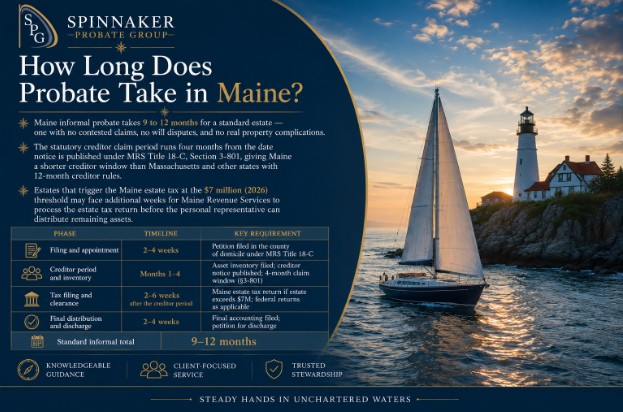
Maine informal probate takes 9 to 12 months for a standard estate — one with no contested claims, no will disputes, and no real property complications.
The statutory creditor claim period runs four months from the date notice is published under MRS Title 18-C, Article 3, giving Maine a shorter creditor window than Massachusetts and other states with 12-month creditor rules.
Estates that trigger the Maine estate tax at the $7 million (2026) threshold may face additional weeks for Maine Revenue Services to process the estate tax return before the personal representative can distribute remaining assets.
| Phase | Timeline | Key Requirement |
| Filing and appointment | 2–4 weeks | Petition filed in the county of domicile under MRS Title 18-C |
| Creditor period and inventory | Months 1–4 | Asset inventory filed; creditor notice published; 4-month claim window (§3-801) |
| Tax filing and clearance | 2–6 weeks after the creditor period | Maine estate tax return if estate exceeds $7M; federal returns as applicable |
| Final distribution and discharge | 2–4 weeks | Final accounting filed; petition for discharge |
| Standard informal total | 9–12 months |
The Maine probate guide breaks down each phase with statute citations and common delay triggers.
Families in Knox County and surrounding areas can review the Rockland probate guide for county-specific procedural details.
The dual credential reduces timeline risk at the tax filing phase. Estates that require both a Maine estate tax return and a federal Form 706 portability election are prepared in-house, eliminating the weeks of coordination delay that occur when a separate accounting firm handles estate tax returns.
What Does Probate Cost in Maine?
In Maine, probate costs a standard estate between $3,000 and $7,000 in total administrative expenses, based on typical caseload ranges. Court filing fees in Maine typically range from $50 to $200 by county.
Every cost above the filing fee scales with the estate’s complexity, creditor claims, tax returns, and real property transfers.
| Cost Component | Typical Range |
| Court filing fee | $50–$200 (varies by county) |
| Attorney fees (standard estate) | $3,000–$7,000+ |
| Real property appraisal | $300–$500 per property |
| State estate tax preparation | Included when handled by a dual-credentialed attorney; $1,500–$3,000+ if outsourced |
| Federal estate tax return (Form 706) | $2,000–$5,000+ if estate exceeds $13.99M (2025) federal exemption |
| Bond premium (if court-ordered) | 0.5%–1% of estate value |
The Maine probate cost guide details each fee category by estate type. The firm prepares state and federal estate tax returns in-house rather than outsourcing to a separate accounting firm, eliminating the $1,500–$3,000 outsourcing cost and the coordination delays between legal counsel and a separate accountant.
A clear cost estimate before filing prevents surprises after the estate is open. Schedule a consultation with Spinnaker Probate Group for a fee projection specific to your Maine estate.
When Can a Maine Estate Avoid Full Probate?
Maine allows certain assets to be transferred entirely outside the formal probate process. Funded revocable living trusts bypass probate because trust assets are not part of the probate estate.
Jointly held property with survivorship rights, payable-on-death accounts, and properly designated beneficiary accounts also transfer directly to named beneficiaries without court involvement.
The Maine Uniform Trust Code (MRS Title 18-B) governs trust administration and defines what “funding” a trust requires to keep assets out of probate court.
Maine offers a simplified small-estate affidavit process for estates under $40,000.00 without any real estate. Families who want to avoid court involvement should structure assets in a trust or as joint ownership before the need arises, through advance estate planning.
How Does the Maine Estate Tax Affect Administration?
Maine imposes a state estate tax on estates valued above $7 million (2026) under MRS Title 18-C. Maine Revenue Services administers the tax through Form 706ME, applying three progressive brackets: 8 percent on the first taxable tier, 10 percent on the middle tier, and 12 percent on the highest tier.
Unlike the federal estate tax exemption, the Maine threshold has no portability — surviving spouses cannot claim the deceased spouse’s unused exemption.
The $7 million threshold shields most Maine families from the state estate tax. Families with substantial real property holdings, business interests, or multi-generational land — including inherited camp properties along the coast or interior — should verify whether combined asset values approach or exceed the threshold.
Personal representatives should also evaluate whether a federal Form 706 portability election is appropriate, even when the estate falls below the $13.99 million (2025) federal threshold.
Filing Form 706 within nine months of death preserves the deceased spouse’s unused exemption for the surviving spouse — an election that must be made on a timely return and cannot be recovered once the deadline passes.
Attorney McClure identifies estate tax exposure during the initial consultation and may prepare both the Maine estate tax return and the federal Form 706 in-house, ensuring the two filings coordinate rather than conflict.
What Happens When a Maine Resident Dies Without a Will?
When a Maine resident dies without a valid will — known as dying intestate — MRS Title 18-C, Article II-A governs the distribution of assets through a fixed statutory hierarchy. The surviving spouse, children, parents, and siblings inherit in a predetermined order that may not reflect the decedent’s actual wishes.
Intestate estates follow the same probate timeline and procedural requirements as testate estates, but the Probate Court appoints a personal representative rather than confirming the individual named in a will.
The intestate succession guide outlines the full statutory hierarchy and the complications Maine families face when no will exists.
The firm’s legal and tax background strengthens its ability to handle intestate administration. Without a will directing specific bequests, the personal representative must divide assets precisely according to statutory shares — a calculation that requires accurate valuations of every asset class in the estate. Families navigating intestate division alongside elder law concerns such as Medicaid recovery or guardianship should raise both issues during the initial consultation.
Frequently Asked Questions
How long does informal probate take in Maine?
Informal probate in Maine closes in 9 to 12 months for a standard estate under MRS Title 18-C. The four-month creditor claim window under Section 3-801 allows estates to reach the distribution phase faster than states with 12-month creditor rules.
What is the Maine estate tax threshold in 2026?
Maine taxes estates valued above $7 million (2026) with progressive brackets of 8, 10, and 12 percent. The threshold has no portability between spouses. Families with real property, business interests, and retirement accounts should verify the combined value against the $7 million threshold.
What does probate cost in Maine?
Court filing fees range from greatly, depending on the value of the estate. Administration costs for a standard Maine estate range from $3,000 to $7,000+, depending on attorney fees, real property appraisals, creditor claims, and whether the estate triggers state or federal estate tax filing requirements.
Can I avoid probate in Maine?
Assets held in funded revocable trusts under MRS Title 18-B, jointly owned property with survivorship rights, payable-on-death accounts, and properly designated beneficiary accounts all transfer outside probate court. Maine does not offer a simplified small-estate affidavit process for low-value estates.
What is the role of a personal representative in Maine?
The personal representative files the probate petition in the county of domicile, inventories all estate assets, notifies creditors through published and direct notice, pays valid debts and taxes, and distributes remaining property to beneficiaries under MRS Title 18-C fiduciary obligations.
What happens if someone dies without a will in Maine?
Maine intestacy statutes under MRS Title 18-C, Article II-A distribute assets through a fixed statutory hierarchy: surviving spouse, then children, then parents, then siblings. The Probate Court appoints a personal representative, and the estate follows the standard 9- to 12-month informal timeline.
Do I need to file a federal estate tax return if the estate is under $13.99 million (2025)?
Often yes — to preserve portability of the deceased spouse’s unused exemption via Form 706. The election must be made on a timely return filed within nine months of death. Missing the nine-month filing deadline permanently forfeits the surviving spouse’s portability benefit.
How does Attorney McClure’s dual credential help with Maine estate administration?
The dual legal and accounting credential allows in-house preparation of estate tax returns, fiduciary income tax returns, and asset valuations without outsourcing to a separate accountant. In-house preparation eliminates outsourcing, and may remove coordination delays, and ensures legal and tax strategies align.
What is the difference between informal and formal probate in Maine?
Informal probate proceeds without court hearings and closes in 9 to 12 months when no interested party contests the will or appointment. Formal probate requires judicial approval at each stage and applies when beneficiaries dispute the will, minors lack guardianship, or assets are in dispute.
How do I get certified copies of probate documents in Maine?
The county Probate Court issues certified copies of wills, Letters of Authority, and other probate documents upon request. The certified copies guide covers the steps for requesting, the required forms, and the fees for each Maine county. Each county clerk accepts requests by mail or in person.
Probate deadlines and tax thresholds do not wait. Schedule a consultation with Spinnaker Probate Group to confirm which probate track applies to your Maine estate and what the realistic timeline looks like.